Pole Barns in Woodbury
Pole barns built for real work
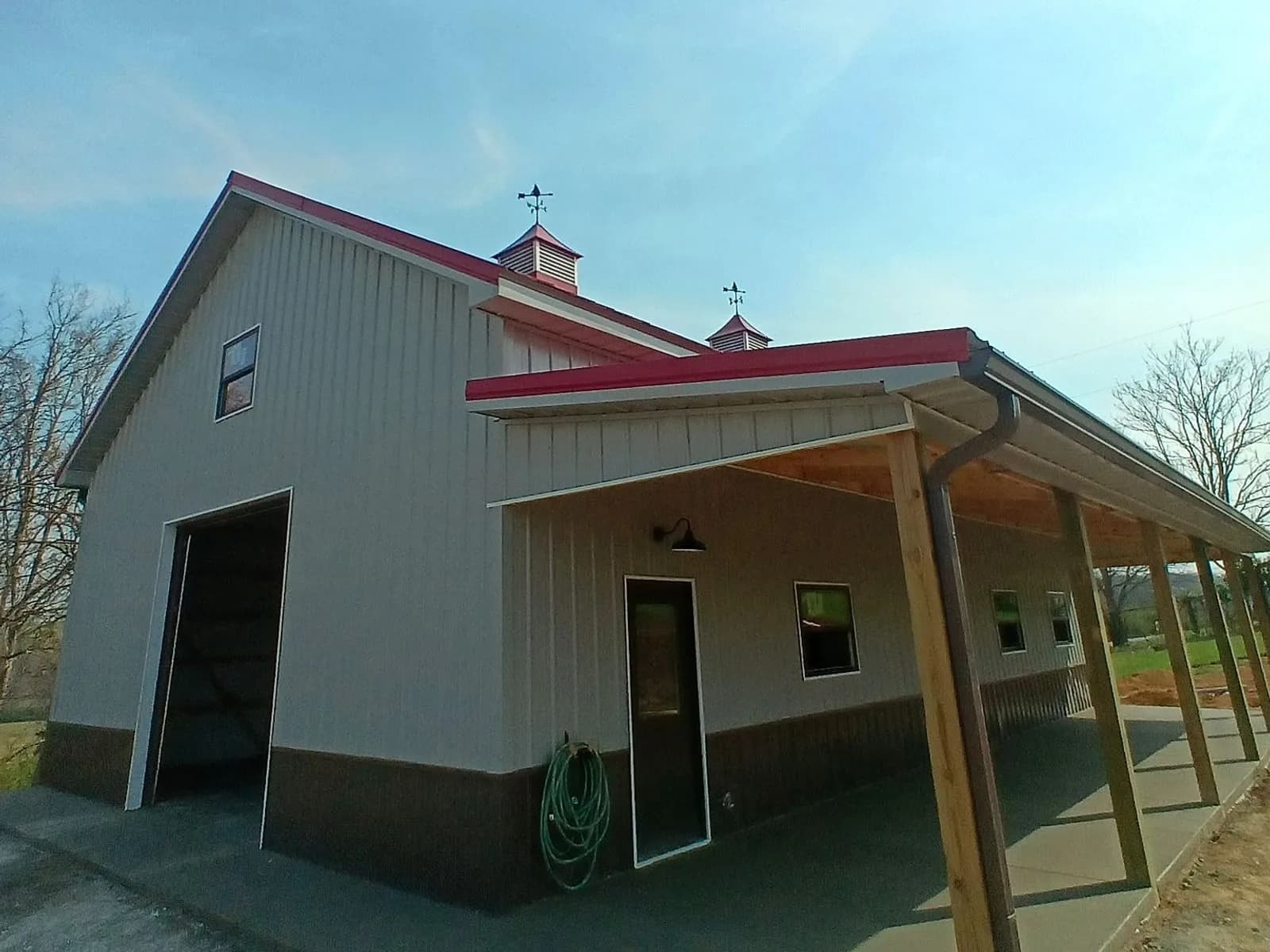
Tennessee Home Builders engineers pole barns for Cannon County farmers, horse owners, and equipment-storage builds that pre-engineered metal shed kits cannot match. Clear-span interiors, deep eave overhangs, sliding equipment doors big enough for a tractor, and engineered load paths sized to Woodbury wind and Cannon County ice loads are what separate a barn that lasts 30 years from one that sags by year 8.
Pole barns engineered for our wind and snow loads
Cannon County weather drives the engineering math on every pole barn we put up. Design wind speed across most of the county runs to a 90 mile-per-hour 3-second gust under current code, with exposure category C on open pasture and category B on tree-sheltered building sites. Snow load runs 10 to 15 pounds per square foot under standard exposure, with localized drifting and valley accumulation pushing design loads higher on steep-pitch barns near taller adjacent structures.
Truss spans match the building width on a clear-span design; 24-foot through 60-foot widths are standard, fabricated off-site by truss plants that stamp engineering drawings and crane-erected on framing day. Truss spacing falls to 8 feet on center for hay storage and equipment barns and tightens to 4 feet on center for finished interior workshops or hobby spaces where the ceiling will hang drywall. Eave overhangs run 1 to 3 feet depending on the side of the barn; wider on the sun-exposed south face to shade interior storage from summer heat, narrower on the wind-exposed north face to reduce uplift load.
Roof pitch follows use: 4-in-12 for storage barns where the loft is open, 6-in-12 for finished interiors, and 8-in-12 for gambrel-roof equestrian barns where the upper level houses hay-loft storage. We engineer to the measured building exposure rather than the minimum table value because a sheltered category-B site allows lower wind loads while an exposed pasture site demands the higher rating. Stamped engineering accompanies every permit submission and lands in the owner's project file at closeout.
Building on a sloped site in Cannon County hill country
Most Woodbury pasture and acreage parcels carry terrain that defeats the standard flat-pad assumption built into catalog pole-barn pricing. Slope across the building pad ranges from gentle 2 percent fall to working sites where the high end of the footprint sits 6 feet above the low end on a 40-foot pad. We grade the building pad level rather than try to step the barn frame, because a stepped pole structure introduces lateral load paths that the post-frame design cannot handle elegantly.
Fill on the downhill side gets brought in, compacted in 6-inch lifts, and stabilized at the perimeter with a retaining wall or a sloped riprap depending on the topography. Post embedment depth adjusts on cut-and-fill pads so every post lands on undisturbed native soil or on engineered compacted fill that meets bearing capacity for the post tributary load. Drainage carries higher engineering weight on a sloped site than on a flat one. Surface water that would have rolled past the future barn location on the unbuilt slope must route around the new structure rather than through it.
We grade swales upslope of the barn to catch sheet flow, route the swale to daylight on either side of the barn, and seed the swale heavily so erosion stays controlled through the first growing season. French drains pick up groundwater on sites where the watertable rides shallow. Significant slope adds to the sitework budget but rarely changes the building cost; we walk the site during scoping with a hand level to confirm the slope is manageable before pricing.
Agricultural use, residential garage, workshop, or barndominium
Pole construction adapts across use cases that demand different finish levels, mechanical infrastructure, and inspection cadences. Agricultural barns prioritize clear floor area for tractors, hay, livestock, or feed storage. The interior stays open and unfinished, the floor often stays gravel or compacted soil rather than concrete, and the electrical surface is limited to a few weather-resistant outlets and basic overhead lighting.
Building permits on agricultural barns on actively-farmed parcels often fall under Cannon County's agricultural exemption. Residential detached garages step up the finish: 4-inch concrete floor with vapor barrier, framed interior walls on the inside face of the pole structure, insulation between the framing, and full residential electrical service. Workshops and hobby spaces add 200-amp service or higher, dedicated 240-volt circuits for welders or wood-shop equipment, LED shop lighting at 60-80 foot-candle levels, and finished walls and ceilings where the owner wants the space to read as interior.
Barndominium framing extends further. The pole structure provides the exterior shell and roof structure while the interior gets framed conventionally for living space, complete with insulated wall assemblies, finished interior walls and ceilings, residential mechanical systems, plumbing, and the full residential permit and inspection cadence. We sketch the finish-tier ladder with the owner during scoping so the permit path, the electrical scope, and the door-and-window package match the use case in front of us rather than over-spec one or under-spec the other.
Where pole construction fits and where stick-framing wins
Pole construction is not always the right choice. We talk owners out of pole barns when the use case fits stick-framed construction better. Stick-framed garages with a finished interior, multiple stories, complicated roof lines, or significant glazing land cleaner as conventional residential framing on a perimeter foundation rather than as a pole structure with retrofit interior walls.
Stick-framed shops with a habitable second story build cleaner with conventional framing because the floor structure of the second story carries through the wall framing rather than hanging off pole-frame posts that were sized for roof load only. Code-required fire separations between attached residential pole construction and existing dwellings sometimes drive owners toward stick-framing because the connection detail is simpler. Conversely, pole construction wins on clear-span interiors over 30 feet wide because conventional framing forces interior bearing walls or expensive engineered beams that pole construction handles with a single truss. Pole construction wins on sites with poor soil where the cost of a perimeter foundation pour is prohibitive.
Pole construction wins on agricultural exempt parcels where the permit and engineering surface is lighter. Pole construction wins on owner-managed sites where the speed of the post-and-truss erection saves weeks against stick-framing's slower framing cadence. The decision deserves the conversation rather than the assumption; we run that conversation early in scoping so the owner picks the right structural type for the work.
Where we work across Woodbury and the Cannon County reach
Pole-barn projects center on Woodbury and the surrounding Cannon County footprint where the rural acreage and the agricultural-exempt building pattern carry our highest project density. We extend into Murfreesboro for owners on the Rutherford County perimeter where mixed agricultural and residential zoning allows pole construction on larger parcels, Nolensville for owners on larger Williamson County lots seeking detached workshops or equestrian barns, Lebanon for Wilson County owners pulling pole construction onto rural acreage east of the city, Smyrna on transitional parcels where pole detached garages serve as backyard workshops, and Shelbyville for Bedford County agricultural projects tied to the equine industry that runs through that area.
Cannon County remains our densest cluster because Daniel grew up here, and the Woodbury inspector and permit office know our crew by name. Drive radius affects scheduling: pole-barn framing crews mobilize equipment, truss delivery trucks need access routes, and the consistent presence pays off on smaller drives.
Outside the 6 priority cities the broader Middle Tennessee service area carries pole work on a project-by-project basis when scope and schedule align. Call Daniel for a site walk if your parcel sits outside the priority cities and we will tell you honestly whether the drive and the project fit our calendar.
Written by Daniel Jernigan
Daniel founded Tennessee Home Builders in 2021 and leads custom home design and build across Middle Tennessee.
Frequently asked questions
Yes. We grade the building pad level rather than try to step the barn frame, set posts on undisturbed native soil or engineered compacted fill, and absorb the topography in surrounding site grading. Sloped sites add to the sitework budget but rarely change the building cost. We walk the site with a hand level during scoping to confirm the slope is manageable and price it accurately before any contract signs.
Most agricultural pole barns finish in 4 to 6 weeks from groundbreaking to final inspection. Sitework runs 1 week, post setting and truss erection runs 1 week, roofing and siding runs 2 weeks, and the door package plus any electrical service runs the last week. Finished interior pole structures, residential detached garages, or barndominium framing extend the schedule to 10 to 16 weeks because of additional mechanical, electrical, plumbing, drywall, and finish work.
Yes. Barndominium framing uses the pole structure as the exterior shell and roof while the interior gets framed conventionally for living space. The permit path becomes full residential rather than agricultural exempt, so footing, framing, mechanical, electrical, and final inspections all apply. Insulated wall assemblies, residential mechanical systems, plumbing rough-in, and code-required fire separations all get engineered into the design at scoping rather than retrofit after the shell is up.
Cannon County design snow load runs 10 to 15 pounds per square foot under standard exposure, with localized drift and valley accumulation pushing design values higher on adjacent-structure sites. Design wind speed runs to a 90 mile-per-hour 3-second gust under current code, with exposure category C on open pasture and category B on tree-sheltered sites. We engineer to the actual building exposure rather than the table minimum, with stamped truss and post-embedment drawings included in every permit submission.
Key Facts
- License
- TN Residential Contractor License # 77609
- Founded
- Cannon-County-rooted post-frame construction since 2021 for agricultural and equestrian owners.
- Projects
- 29+ completed projects across Middle Tennessee
- Service Area
- Pole-barn footprint covers 20 cities across 8 counties.
- Signature
- Engineered post embedment, clear-span trusses, load paths sized to local weather.
We serve homeowners across Middle Tennessee
From the office in Murfreesboro, we build, renovate, and improve homes in Murfreesboro, Christiana, Eagleville, Lebanon, Nolensville, Shelbyville, Smyrna, and Woodbury.
Explore our other services
Ready to start your pole barn?
Tell us about your site, your timeline, and what you have in mind. We’ll come back within 24 hours.