
Covered Patios in Murfreesboro
Outdoor rooms you will actually use
A covered porch becomes the most-used square footage of a Murfreesboro house once families discover what an outdoor ceiling feels like in July rain or October dusk. The structural and mechanical details that make it work year-round are the part most builders shortcut, and the part we engineer first.
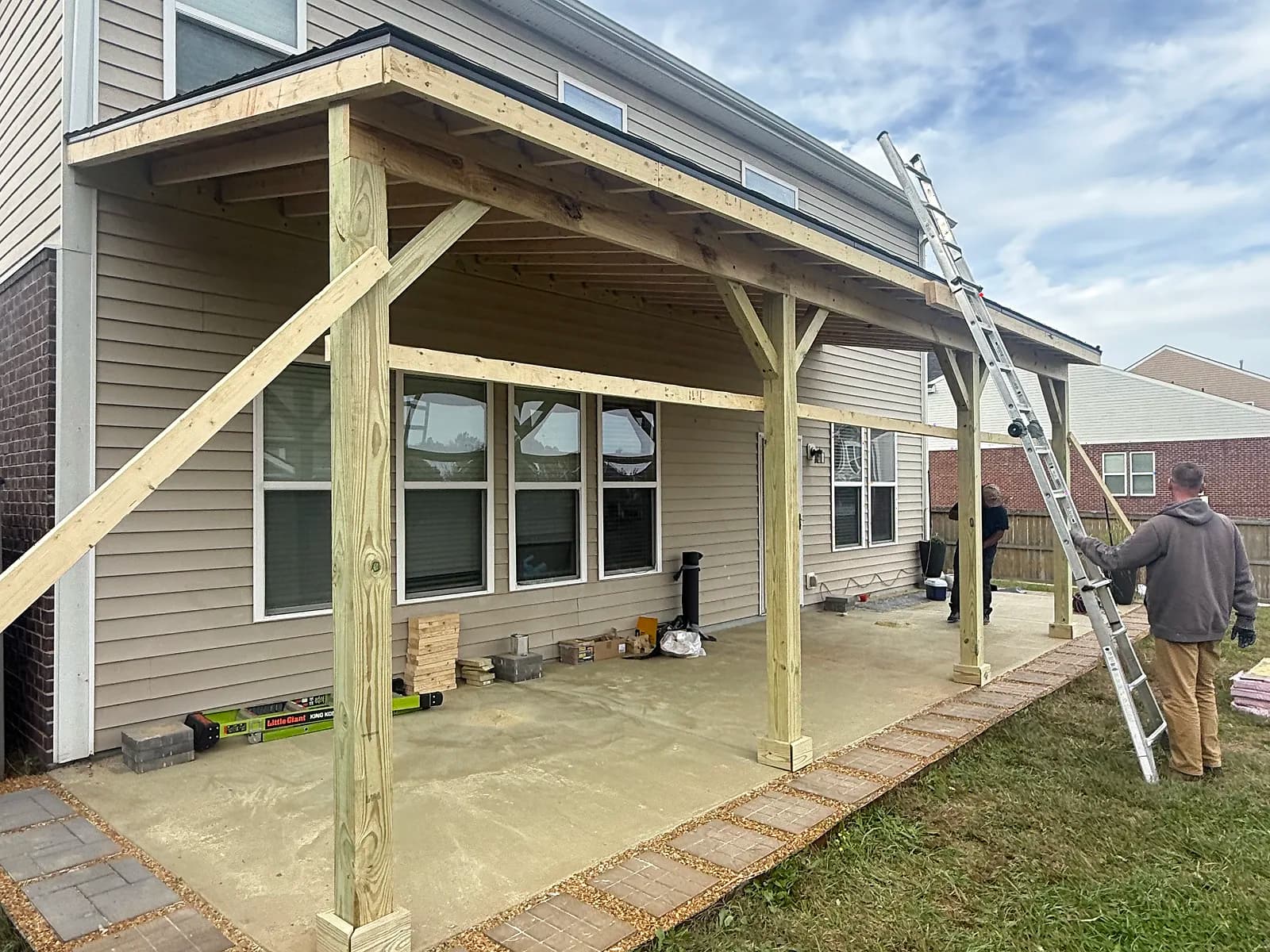
Outdoor rooms that earn their square footage every season
A covered porch sized and finished correctly carries weight across four seasons rather than serving as a three-month afterthought. Spring evenings open the porch as a dinner room when the inside dining table feels closed in. Summer afternoons turn it into the shaded reading room a screened ceiling and a stout fan can produce in 95-degree Rutherford County humidity. Fall evenings shift to overhead heaters, a propane fire pit, and dinner that runs past sunset.
Winter still hosts gatherings on the calmer days when wind-side screens block the breeze and the ceiling heaters take the chill off. Open-cover porches anchor the simplest version of this experience: a roofed but otherwise open exterior space that lets the breeze through and the light fall slant. Screened porches add insect control for the dusk hours when mosquitoes peak.
Fully-enclosed three-season rooms wrap the same shape in operable windows so the porch reads as an interior room on the chilly weeks and an outdoor one when the windows slide open. Optional outdoor kitchens integrate a built-in grill, a refrigerator drawer, and counter prep so the family routine migrates outside on any dry evening. The shape of the porch follows the household pattern. We sketch use cases with the owner during scoping, then size the structure to the rhythm of the family rather than a generic catalog template.
Structural roof-tie or freestanding posts and footings
Two structural approaches frame every covered porch. Roof-tie construction sisters new framing into the existing house roof at a ledger board attached to the rim joist or the wall studs through engineered fasteners. The ledger detail is the leak-prone joint, so we install metal counter-flashing, self-adhered membrane underlayment over the entire ledger, and kicked-out flashing where the new porch roof meets the rake corner of the existing roof.
Sistering rafters into the existing roof structure requires verifying the existing rafters can carry the additional tributary load; we engineer that on every project rather than assume the existing roof is oversized. Freestanding construction uses dedicated posts and a separate roof structure that abuts the house without structural dependency on it. Freestanding works on porches where the existing roof line cannot accept a ledger cleanly, where the existing rafters are undersized for additional load, or where the architecture calls for a clearly separate outdoor structure.
Posts sit on concrete piers dug below the 24-inch frost line in Middle Tennessee, with galvanized post bases anchored on cured concrete and structural lag screws driven into solid post grain. We default to engineered footing depths and post bases on any porch over 200 square feet, with stamped drawings the owner can hand to a future appraiser or insurance underwriter. Concrete pucks set on grade are how owner-built porches develop visible deflection within five years; that is not how we build.
Ceiling fans, lighting, outlets, and optional gas drops
Electrical and mechanical infrastructure on a porch differs from interior work because outdoor humidity, wind-driven moisture, and dynamic ceiling loads change what code requires. Ceiling fans for porches must use damp-location or wet-location rated motors, mounted in listed outdoor fan boxes sized for the actual fan weight plus dynamic load. Interior fan boxes pull out of porch ceilings within five years, and the failure mode is a heavy fan landing on whoever was below it. We block every fan location during framing and pre-position the outdoor fan box before drywall closes the ceiling.
Lighting layers across ambient, accent, and task. Surface-mount fixtures with sealed gaskets handle the overhead ambient role better than recessed cans, which collect insects and water in outdoor service. Sconce or pendant accent lighting at the seating zones reads more welcoming than fluorescent flood.
Step lights on any porch stair prevent missteps in the dark. Code-required GFCI outlets run at exterior intervals along the perimeter, with a dedicated 20-amp circuit for any planned heater or grill load and a separate circuit for the television if the owner wants outdoor entertainment. Optional gas drops support a built-in grill, an outdoor fire feature, or a heating appliance; we coordinate the gas service capacity with the existing residential meter rather than discover under-sized supply during a winter Thanksgiving. Switching layout puts a 3-way at every porch entry so the owner does not walk into a dark room from the kitchen.
Drainage, grading, and the slope away from the house
Water shed off a covered porch needs a planned destination, not a wishful pour. Concrete porch slabs slope a minimum of a quarter inch per foot away from the house foundation, with the high point at the wall and the low point at the outer edge. The fall continues into the surrounding landscape grading so storm runoff routes to a swale or French drain rather than puddling against the foundation.
Gutter sizing on the porch roof scales to the actual roof area; the downspouts route to splash blocks placed at least 5 feet from the foundation, ideally into a buried 4-inch drain pipe that surfaces at a swale outlet. We see DIY porches discharge gutter water 18 inches from the foundation and create the soil-saturation problem that eventually undermines the porch footings the owner just paid to engineer. French drain integration helps on flat lots where natural fall is limited; the perforated 4-inch pipe in a gravel bed picks up sheet flow off the porch slab and routes it laterally to daylight at a graded outlet.
Driveway and patio drains can interact with porch drainage; we map the full storm path during design rather than discover during the first heavy rain that the porch drains feed into a downstream low spot that floods the garage. Ledger flashing and the porch roof drip edge handle the airborne moisture, the slab slope handles the ground moisture, and the perimeter grading handles the soil moisture. All three layers work together; weakening one shifts the load to the others until something gives.
Where we work
Covered porch projects across our Middle Tennessee footprint anchor on the 6 priority cities where Tennessee Home Builders concentrates field presence. We build covered porches in Murfreesboro where most of our porch-as-keystone-room projects land, Nolensville on larger rural lots that justify outdoor kitchens and screened ceilings, Lebanon for owners pulling porch additions into older homes east of the city, Smyrna for owners modernizing 1990s-2010s subdivision builds with outdoor extensions, Shelbyville for owners on rural acreage who want a fully-enclosed three-season room facing pasture, and Woodbury where Cannon County porch additions often tie into pole-barn outbuildings or detached workshop structures.
Each city carries its own permit cadence and building department rhythm; we know the inspectors by name and the typical turnaround per jurisdiction. Outside the priority six, we serve the broader Middle Tennessee service area on a project-by-project basis when the scope, the drive, and the schedule align.
The drive radius matters because porch work runs 4 to 8 weeks on the typical project, and consistent field-crew presence prevents the schedule slippage that long drives produce. Pick the city closest to your lot for the city-specific introduction, or call Daniel directly to walk through your project regardless of city.
Written by Daniel Jernigan
Daniel founded Tennessee Home Builders in 2021 and leads custom home design and build across Middle Tennessee.
Frequently asked questions
Often yes. The ledger detail joining the porch roof to the existing house wall is the leak-prone joint we engineer with metal counter-flashing, self-adhered membrane underlayment, and kicked-out flashing at the rake corner. Shingle exposure matches the existing house roof and gutter detailing ties in so the porch reads as part of the architecture rather than strapped on. When the existing rafters cannot carry the additional tributary load, we shift to a freestanding structure with dedicated posts and a separate roof framing system.
Yes. Any roofed exterior structure in Rutherford County requires a residential building permit and an inspection sequence covering footings, framing, mechanical and electrical rough-in, and final. We pull the permit and coordinate every inspection. Adding a roofed porch to an existing dwelling also affects deed-recorded square footage in most Middle Tennessee jurisdictions, so the as-built recorded drawing follows completion. Inspections add about 2 weeks to the calendar, which we factor into the schedule at scoping.
Yes, if we pre-plan the infrastructure during the porch build. The gas drop, water supply, drain line, dedicated electrical circuits, and the structural floor capacity for a built-in grill all get framed in during the initial porch construction. Adding those after the porch is finished forces tear-out of the slab, the ceiling, or the back wall depending on which utility we need to route. Many owners stage the outdoor kitchen 12 to 24 months after the porch construction once the family use rhythm settles, and the pre-planned infrastructure makes the second phase a clean tie-in.
Most Rutherford County appraisers count covered porches as covered outdoor living area rather than conditioned interior square footage, so the resale impact shows up in the listing photograph and the buyer-agent walk-through rather than in the formal square footage line. Outdoor-room finish quality, integrated lighting, ceiling material, and the architectural integration with the existing house all contribute to the appraised value adjustment the comparable-sales analysis assigns. We hand owners the engineered drawings and inspection records at closing so the porch carries a paper trail any future appraiser can document.
Key Facts
- License
- TN Residential Contractor License # 77609
- Founded
- Engineering covered outdoor rooms in Middle Tennessee since 2021 with footings tuned to local freeze-thaw cycles.
- Projects
- 29+ completed projects across Middle Tennessee
- Service Area
- 20 cities and 8 counties of Middle Tennessee on the porch calendar.
- Signature
- Engineered footings, ledger flashing detail, drainage planned at design time.
We serve homeowners across Middle Tennessee
From the office in Murfreesboro, we build, renovate, and improve homes in Murfreesboro, Christiana, Eagleville, Lebanon, Nolensville, Shelbyville, Smyrna, and Woodbury.
Explore our other services
Ready to start your covered patio project?
Tell us about your site, your timeline, and what you have in mind. We’ll come back within 24 hours.